


I started using the Renpho Smart Scale three years ago. My boyfriend and his friend both had it, but I liked it so much I ended up buying it for myself too. It has been instrumental in helping me achieve some fitness goals (like losing the 15 lbs I gained during my first year at a new job). So I thought it time to do a proper Renpho scale review.
In this post, I’ll outline the features of the Renpho scale and how it works, and discuss its accuracy (a hot debate when it comes to body composition scales). Finally, I’ll go over my experience with the scale and how it’s shifted my approach to fitness.
- Renpho Scale Review: Quick Facts
- What does it do?
- How does it work?
- Is it accurate?
- My experience and review
Renpho Scale Review

Quick Facts
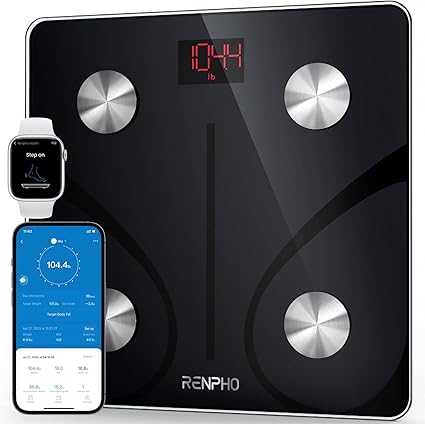
- Syncs with fitness apps and fitness trackers
- Measures 13 fitness metrics, including weight BMI and body composition
- Renpho app tracks trends over time
- 4 high sensitive electrodes (for measuring body composition)
- CE, FCC ,ROHS Certificated.
- Check full product specs here
Renpho Smart Scale: What does it do?
Beyond just measuring your body weight, there are two features about Renpho that make it so useful: App Integration and Body Composition.
App Integration
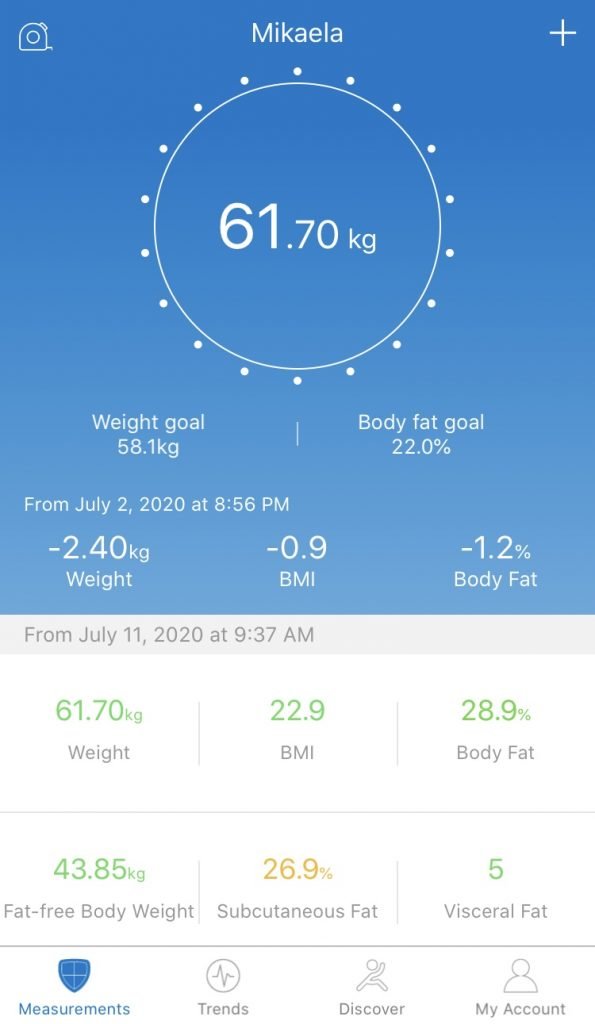
The Renpho Smart Scale is a bluetooth scale that connects to the Renpho App on your smartphone. This Bluetooth smart scale can also connect to fitness trackers and smart watches. When you stand on the scale, all the information recorded will show up on your phone. Because all the data is stored in the app, you can easily track progress over time. The Trends tab on the app show a line graph of how your progress against each metric.
App Homepage
Trends Page
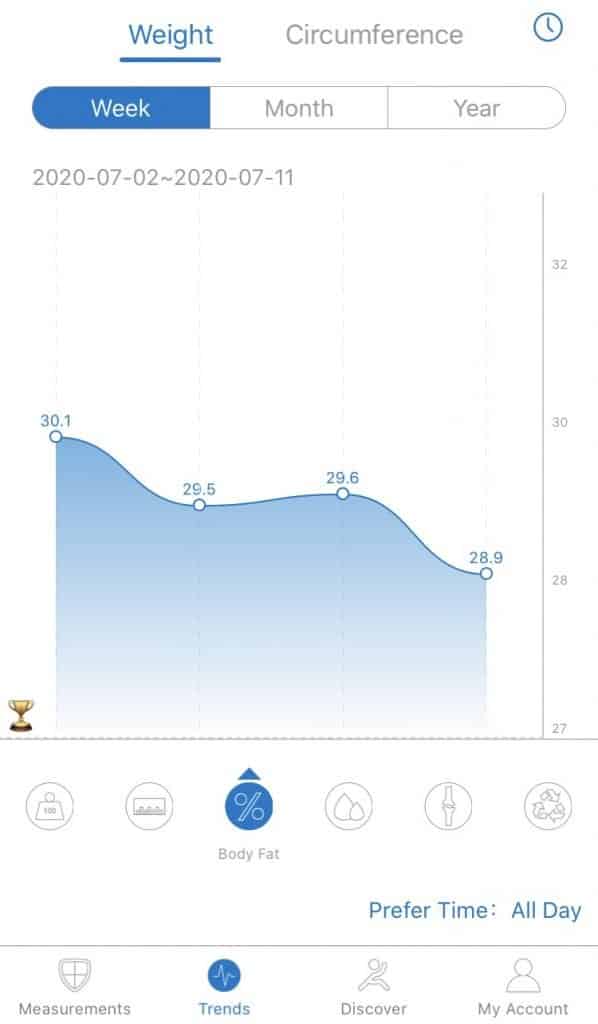
Note: Since June 2019 I had been using the App on my boyfriend’s phone, but in July 2020 purchased the scale and downloaded the app for myself, which is why the app only shows my progress since July 2, 2020.
Body Composition
The Renpho Smart Scale measures your body weight in addition to 12 other metrics like BMI, body fat percentage, muscle mass and basal metabolic rate.
Why is this important?
Regular scales only tell you your weight, and I’ve long had issues with these types of scales. Your weight is affected by your height, muscle mass, water retention if you’ve eaten recently and a myriad of other factors.
And it isn’t necessarily a good gauge of fitness progress either. Muscle weighs more than fat, so you could positively change your body composition but see little change in terms of your weight.
That’s why I find Renpho Smart Scale so helpful. In addition to your weight, it also determines your body fat percentage, which is much more helpful in tracking fitness progress. So no, if you do strength training and see that your weight hasn’t changed that much, you can see that your body fat percentage actually went down and you put on a bit of muscle.
How does the Renpho Smart Scale work?
How does Renpho Scale work and how does the Renpho calculate body fat are frequently asked questions. There are sensors on the top of the scale (the silver circles in the photos). When you step on the scale, the sensors send a small electrical current through your body. The current is so small you don’t feel anything.
The current is used to do a Bioelectrical Impedance Analysis, which estimates body fat percentage based on the amount of resistance the current encounters.
Body fat causes more resistance than muscle. The Renpho Body Fat Scale measures how much resistance there is to determine the body fat percentage and other metrics. You can read more about how Bioelectrical Impedance Analysis works by reading this article.
Is the Renpho Smart Scale accurate?
After using the scale for almost a year, I believe it to be fairly accurate. But let’s ask the professionals about Renpho scale accuracy:
According to this article by HealthLine, scales (like Renpho) do a good job of estimating body fat percentage and similar metrics, but the results can be skewed by your gender, your height and stature and your exercise frequency.
The Renpho smart scale app asks for your height and gender when you set up the app, which helps make the Renpho body fat accuracy better than the scales that don’t use this data.
On the other hand, this article by Medical New Today references a study that found body fat percentage scales could be up to 35% inaccurate (they don’t mention if they used Renpho as one of the scales in the study and hence I can’t comment specifically on how accurate Renpho scale is).
There are more accurate ways to measure body composition (a Hydrodensitometry Test and Body Pod are considered to be the most accurate methods). But those require you to go to a fitness centre or clinic.
Both articles said that body fat percentage scales are good enough estimates that you can use them to measure changes in your body over time. So don’t get hung up on the exact percentage you see on the Renpho scale app, but rather how that number is trending over time.
My Experience with the Renpho Smart Scale
As I said, I’ve been using the Renpho Smart Scale for almost a year now. Though admittedly I haven’t been super consistent with my exercise and nutrition during that time. In the last six months I got much more serious about it and have made positive progress since them. Most notably, I’ve lost 16 lbs and decreased my body fat percentage by 2.3%. I still have more to go to get to my goals, but it’s been super helpful having a scale and app that track progress together.
I started using the app when I learned I was ‘overweight’
The reason I started using the Renpho scale was because I wanted to decrease my body fat percentage. After my first year on a new job I had gained about 15 lbs.
Yet I was still considered to be a healthy weight (68.9 kg at 5’5). I was somewhat active and ate reasonably healthy (but ate way more sweets than would be advised). And because I store all my fat around my hips and legs, which is easily hidden under the flowy dresses and skirts I love, my friends and family didn’t notice I’d gained weight.
But I was hovering around 31.7% body fat. For context, 32% is considered overweight / obese for women.
So I was a rounding error away from being overweight. And I was experiencing it too. My knees and lower back were so sore and it was starting to affect my hiking and outdoor adventure activities.
That was a rather rude awakening. My lifestyle had been much more stationary and I was eating out way more than normal, but it wasn’t until I stepped on the Renpho scale that I appreciated just how much my body had changed. Sure, 15 lbs isn’t a lot. But I definitely (and dramatically) increased my body fat percentage during that year. Plus, I was sluggish and self-conscious and tired all the time.
So rather than putting so much emphasis on changing my supposedly-already-healthy weight, I started tracking my body fat percentage. And that has been much more useful than fat alone.
Tracking trends is extremely helpful
My favourite feature of the app is that it integrates with an app and automatically tracks my progress. I can quickly view how my weight, body composition and other metrics have fluctuated since I first got the app.
The scale alone is not enough to promote changes
Having the scale wasn’t enough to hold me accountable to my fitness goals. When I look back on my last year of progress, my Renpho scale measurements go up almost as much as they go down. However I can see from the trends the periods where I had the most progress, and those periods were when I was consistent with a workout and meal plan that I could sustainably follow.
I recently got an Apple Watch with a fitness tracker, and that paired with the Renpho scale have been the real game changer. With the Apple Watch, I get notifications to move more and stand. And my workouts are tracked by time, heart rate and number of calories burned, which I’ve found to be extremely helpful in keeping me motivated during workouts.
Then, I’m further motivated when I see the results reflected on the Renpho scale that show I’m making progress.
Some metrics are more useful (and accurate) than others
Understanding Renpho scale measurements can be a bit challenging. But I really only use the scale for body weight and body composition. Some of the metrics, like Renpho muscle mass and Renpho bone mass, Renpho protein percentage just aren’t as useful to me. There are other metrics that I have no idea how they calculate, so I ignore them (subcutaneous fat, for example).
Renpho Smart Scale Review: Final Verdict
I think this is an excellent scale to buy if you’re serious about tracking your fitness progress over time. Remember that simply having a better scale doesn’t lead to better fitness – that comes with hard work and self-discipline. But if you’re committed to putting in the work to improve your health, I think the Renpho Scale is an essential tool. I very much recommend it.

Stay in Touch
Join our community of outdoor adventurers - you'll find trip inspiration, gear discussions, route recommendations, new friends and more!
Hi, Mikaela. Thanks for the informative review. I purchased one of their scales, but can’t find an answer to a basic question. I have a Muscle Mass of 112.2. What does this number represent? It can’t be percentage, obviously. I don’t think it’s pounds, since I weight 142 lbs and have 24.4 lbs of body fat (17.2%), since I have way more water and other weight than the 6 pounds left over. So what is the 112.2? Thanks
That’s a good question Alain – I typically ignore that metric because it doesn’t make sense to me either. I know the measure is in pounds, and it includes muscles/bones/tendons/connective tissue, but I still don’t think it should be that high. So I’m not sure what it’s supposed to mean. Sorry that isn’t more helpful!
From the Renpho.com site:
Muscle mass is a key measurement of the muscles in your body in pounds or kilograms. This measure plays an important role in your overall fitness, as muscles burn energy and fat all the time. As your muscles mass increases. Your body is able to burn calories or energy faster, which has the effect of increasing weight loss. Muscle mass includes the measurement of the smooth and skeletal muscles as well as water in the body.
I have a question on another subject: Once you get to your target weight how to you change to another target weight? By the way I love my Scale.